
Publications
Property Rights Without Transfer Rights: A Study of Indian Land Allotment
Journal of Political Economy: Microeconomics, forthcoming.
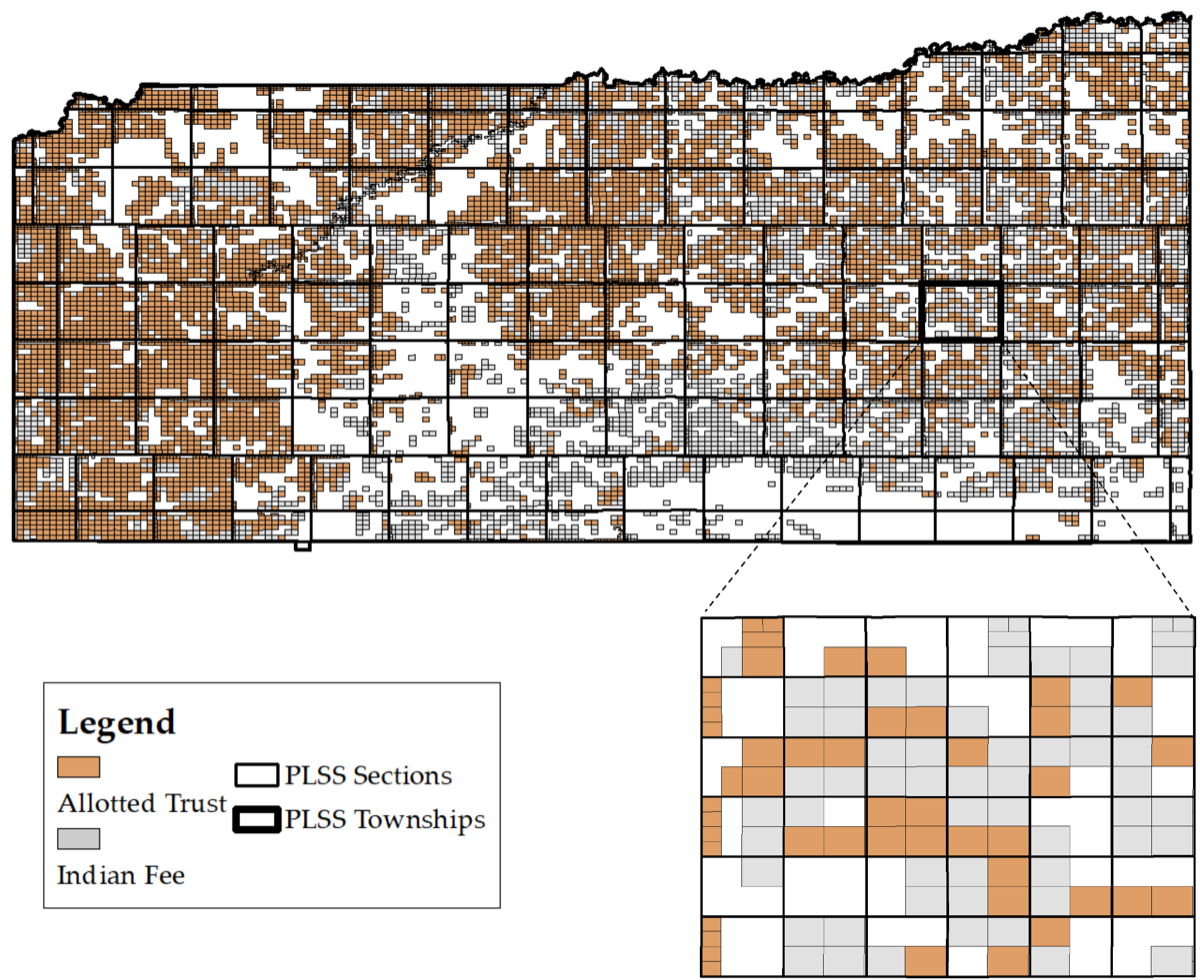
Governments often institute transferability restrictions over property rights to protect owners and communities, but these restrictions impose costs: lowering property values, limiting investment, and increasing transaction costs. We study the long-run impacts of transferability restrictions using a natural experiment affecting millions of acres of Native American reservation land, by comparing non-transferable allotted-trust parcels with transferable fee-simple parcels. We use satellite imagery to study differences in land use across tenure types by leveraging fine-grained fixed effects to compare immediate neighbors. We find that fee-simple plots are 13% more likely to be developed and have 35% more land in cultivation.
Transportation Networks and the Geographic Concentration of Employment
Review of Economics and Statistics, 108(2), 514–524, 2026.
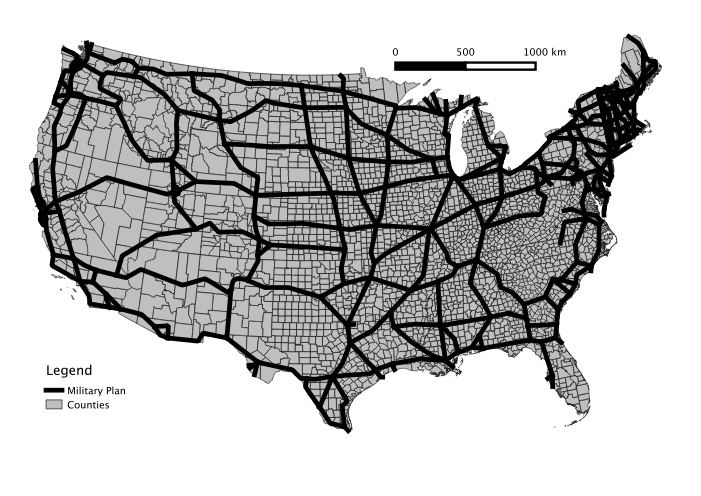
This paper examines the effect of expanding transportation networks on uneven spatial industrial growth across the United States from 1953 to 2016. The paper addresses the endogenous placement and timing of interstate construction by instrumenting for highway locations using a historic military map combined with a network theory algorithm to predict construction timing. Results indicate that interstate counties experienced significant growth in employment and the number of establishments relative to non-interstate counties. Growth rates are highest within two decades of receiving an interstate. The results also reveal positive spillovers occurred in later decades among adjacent counties along the metropolitan periphery.
Bureaucratic Discretion in Policy Implementation: Evidence from the Allotment Era
Public Choice, 199, 193–211, 2024.
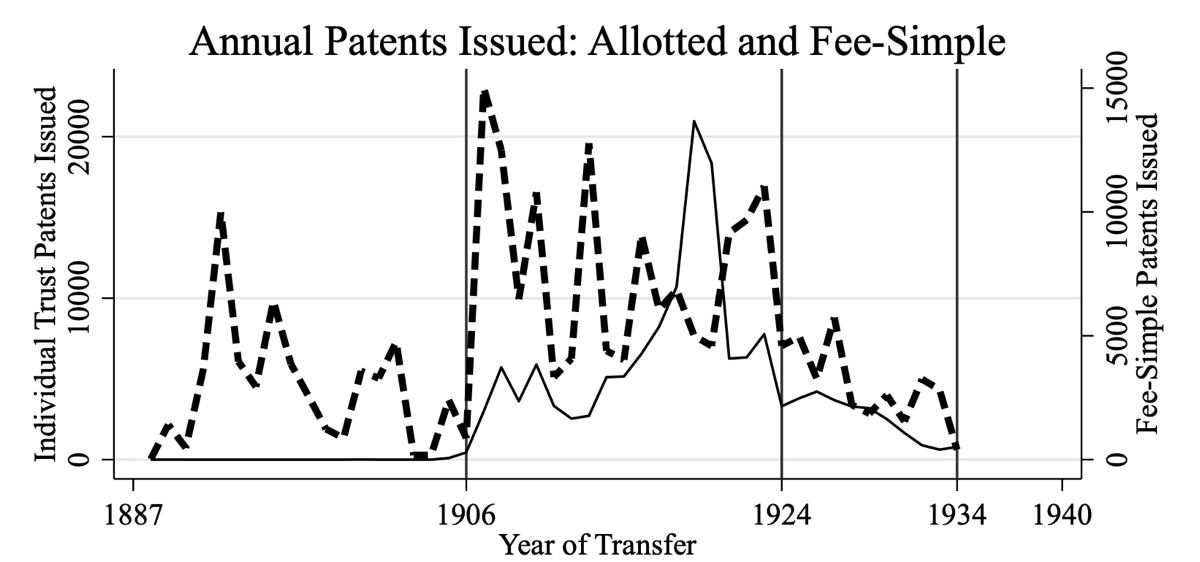
From 1887 to 1934, the federal government broke up millions of acres of tribally owned reservation lands and allotted them to individual Native American households. Allotment conveyed a highly contingent set of property rights, with land initially held in trust by the federal government and administered by the Bureau of Indian Affairs, from which it could later be re-titled into fee simple. The BIA's local "Indian Agents" were given a crucial role in this process. This paper studies empirically to what extent agents' idiosyncratic preferences and discretion shaped this process. We find that individual agents were statistically important drivers of policy implementation, and that their legacies matter for the distribution of land titles on reservations even to the present day.
Indigenous Self-Governance and Development on American Indian Reservations
AEA Papers and Proceedings, 111, 233–237, 2021.
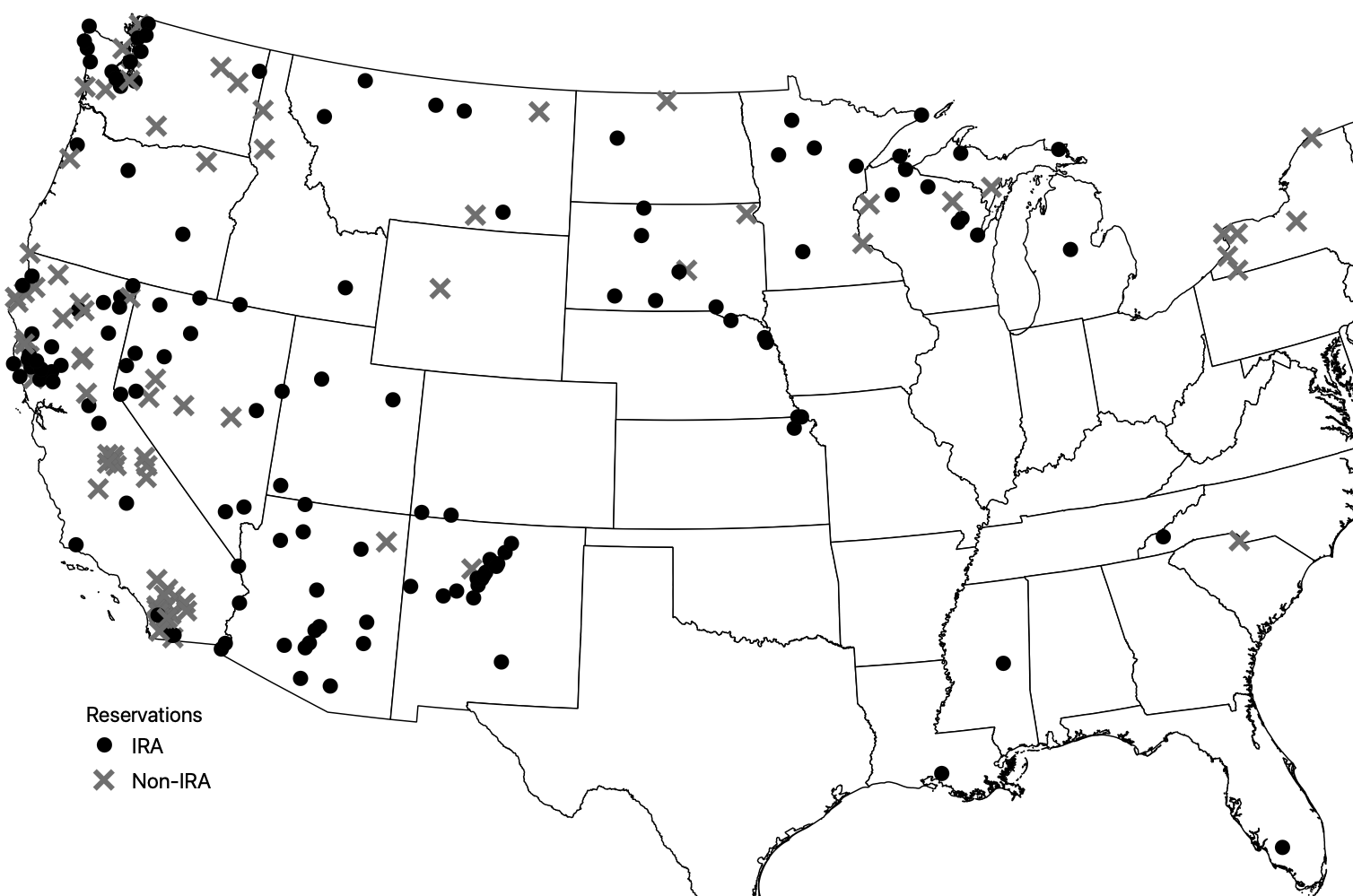
The UN Declaration on the Rights of Indigenous People promotes self-governance as a matter of justice rather than economics. How will self-governance affect the incomes of indigenous people? To gain insight, we compare long-run income growth on American Indian reservations with and without federal oversight through the 1934 Indian Reorganization Act. Reservations with more autonomy had 12–15 percent higher income per capita in 2016, even conditional on 1930s income. However, these more autonomous reservations also experienced wider income variance with more downside risk. The findings are consistent with theory emphasizing the development trade-offs between local and centralized governance.
Working Papers
Economic Consequences of Childhood Exposure to Urban Environmental Toxins
Revisions Resubmitted.
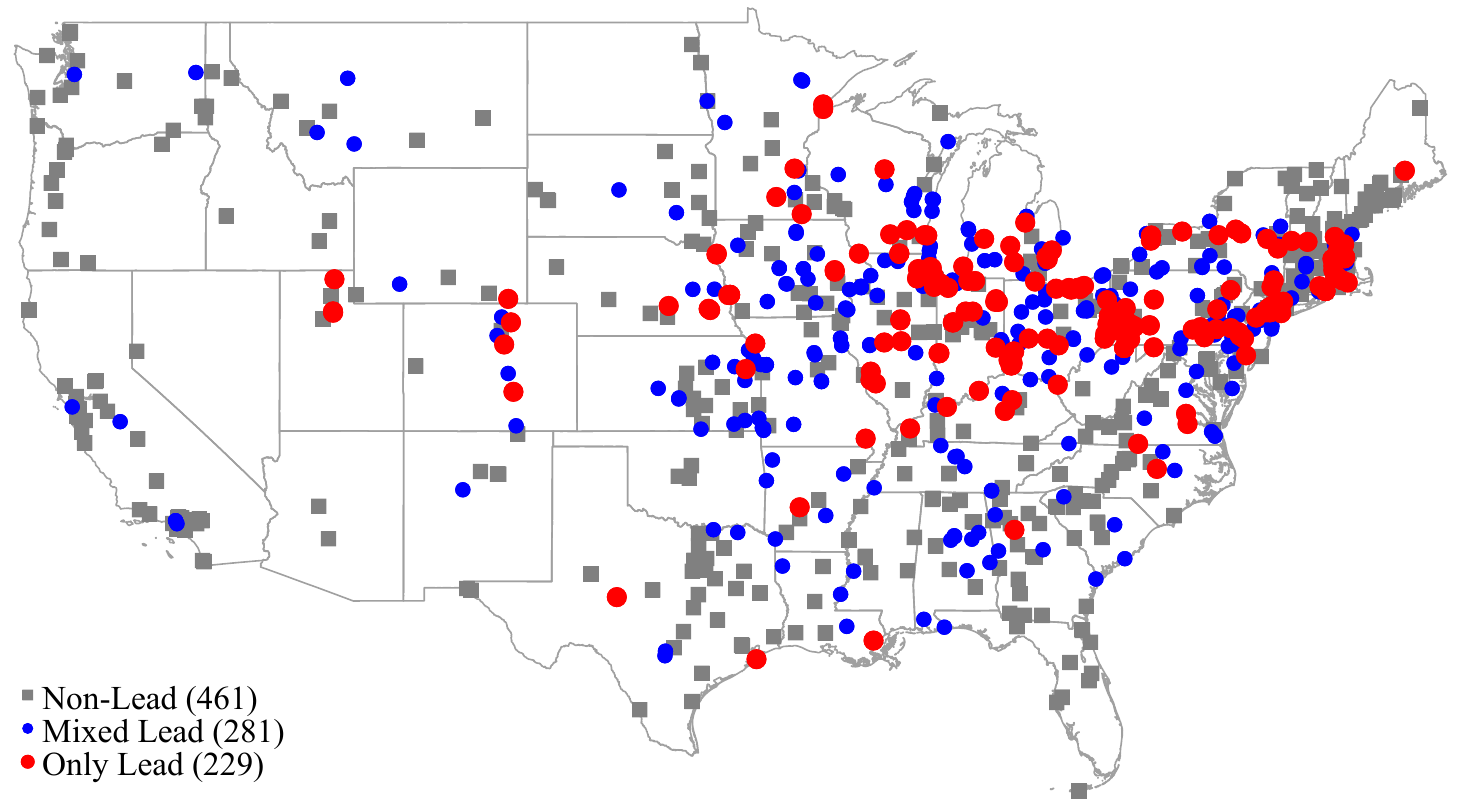
We estimate the effect of childhood waterborne lead exposure on adult labor market outcomes by linking 6.1 million men, ages 20–50 in the 1940 full-count U.S. Census, to their childhood census records across 971 towns. Identification comes from the interaction of municipal pipe material with geologically determined water chemistry: corrosive water draws more lead from service pipes than non corrosive water. Men who grew up in lead-pipe towns with corrosive water were equally likely to be in the labor force as men from non-lead towns with similarly corrosive water, but were more likely to be unemployed, held lower-scoring occupations, and earned 3.4% less in wage and salary income. The penalty operates through occupational sorting, exposed men were less likely to be in professional and managerial jobs and more likely to be in service and laboring work that pays less and requires fewer years of schooling. The linked childhood records let us examine heterogeneity by socioeconomic status and other household characteristics. The penalty is broadly shared, flattening the relationship between a father's income rank and his son's adult earnings and reaching children across the socioeconomic spectrum, not only the poor. These estimates imply substantial, persistent economic costs of waterborne lead, relevant to the cost-benefit case for replacing the lead service lines still in use today.
Welfare Gains from Market Integration Under Competing Land Uses
Preliminary conference draft.
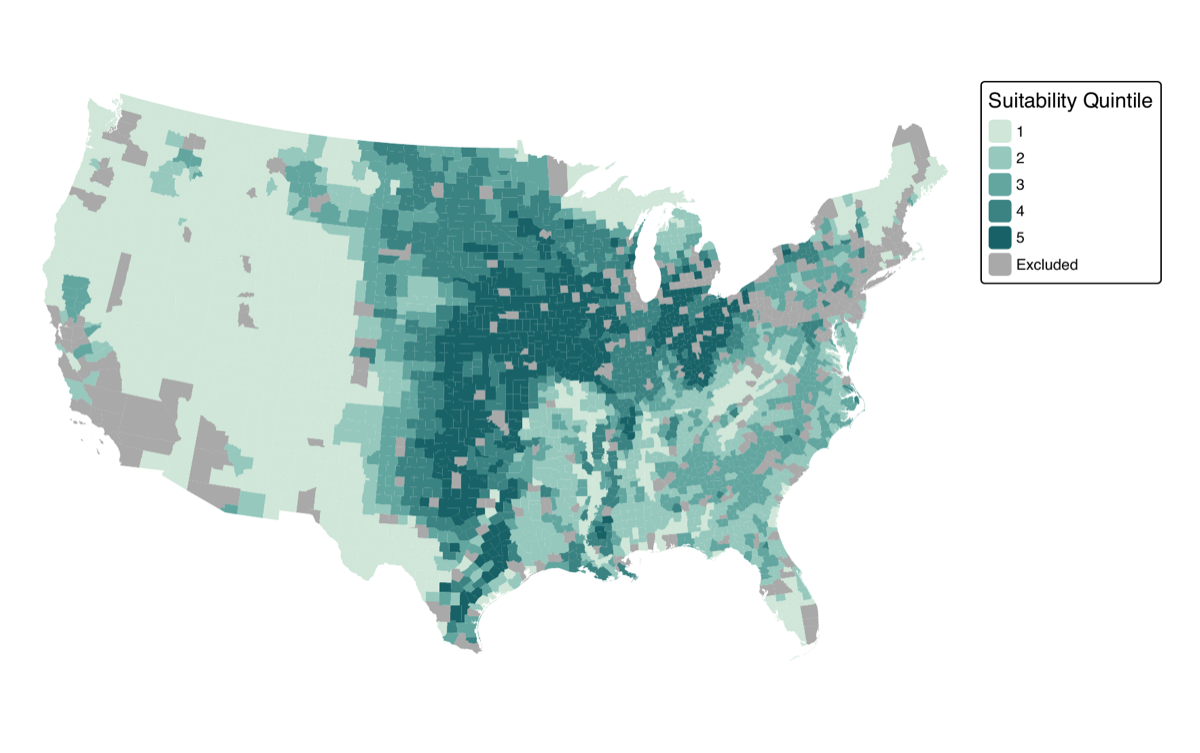
The welfare gains from agricultural market integration are conventionally measured by the capitalization of market access into farmland values — an aggregate measure that omits parcels converting to non-agricultural use, which exit the Census of Agriculture's sampling frame and render farmland values a lower-bound measure of welfare gains. Using the staggered rollout of the U.S. Interstate Highway System (1940–2002), we trace where the gains accrued. Farmland values rose about 11% after a highway arrived, masking a divergence between value and cultivated acreage: the least-suitable land was retained through a shift toward livestock, middle-suitability land lost crop acreage to conversion where development pressure bound, and the best land capitalized the development option into farmland value. Combining this heterogeneity with a Fréchet productivity model and a minimum-distance GMM over development-pressure bins, we identify the parcels the aggregate omits and value them at observed developer bids at as much as $195–210 billion, concentrated on the high-development pressure fringe.
Land Development Along National Highway Networks
This paper examines the impact of interstate highways on land development across the United States. First, by considering the intensity of building construction from 1955 to 2015 measured at the 1 km x 1 km grid cell level. Next, it considers the share of developed land using land cover data from 1974 to 2015. For identification, the paper uses proposed but never built highway segments from a 1920s interstate plan as counterfactual interstate locations. Results indicate that interstates significantly increased land development. These gains are strongest among commercial and industrial land and are concentrated within 5 kilometers of interstates.
The Effect of Land Allotment on Native American Households During the Assimilation Era
In the early twentieth century, the U.S. government sought to culturally assimilate the hundreds of thousands of Native Americans living on reservations. One key mechanism was the Dawes Act (1887), which broke up tribally held lands and allotted them to individual Native households. We draw on newly digitized data sources, including Bureau of Indian Affairs annual reports, the universe of Indian allotments from the Bureau of Land Management, the 1935/36 Indian Census Rolls, and the complete count U.S. Censuses from 1900 to 1940. Using a probabilistic matching algorithm, we link individuals from the Indian Census Rolls to the 1940 Census, allowing us to observe their property rights status and census outcomes. Additionally, we construct data on the movements of local Indian Agents across reservations from 1880 to 1940. This enables us to examine how property rights changes—shaped by these agents—affected households' wages, schooling, and their adoption of outward practices that federal policymakers promoted as signs of cultural assimilation.
Colonial Definitions of Indigenous Identity and Modern Inequality on American Indian Reservations
Colonial systems have been used throughout the world to define indigenous identity in ways not employed by indigenous people prior to colonization. We study how a particular definition—blood quantum—has affected modern inequality and conflict among people self-identifying as Indigenous on American Indian Nations. We construct a 1945–2010 panel data set of reservations to i) estimate how inequality and conflict have evolved with income growth, and to ii) evaluate how these changes vary with a reservation's degree of blood quantum polarization as measured in 1938 Bureau of Indian Affairs reports. Our measure of polarization pivots on the federal government's (arbitrary) threshold of 25 percent Indian blood and peaks when half of the population was above the threshold. We find that higher polarization is associated with less inclusive growth and higher rates of reported conflict. The effects are strongest with increases in casino gaming and for tribes with IRA-era constitutions that embedded blood quantum criteria for citizenship. We also find that measures of cultural polarization—such as polarization in the percent of the Native American population speaking the indigenous language or the coexistence of multiple tribal groups on the same reservation—do not associate with exclusive growth. We interpret this and related findings as further evidence that political rules around the blood quantum threshold—rather than cultural heterogeneity—explain the empirical patterns.
Local versus Central Governance: Long-Run Effects of Federal Oversight over American Indian Reservations
This paper studies the decentralization of governance across American Indian reservations and measures the long-run development differences for reservations that were granted less sovereignty through the Indian Reorganization Act (IRA). To mitigate selection concerns regarding IRA adoption, we exploit voting results by restricting our analysis to narrowly determined elections. Results indicate that IRA adoption stifled economic development, resulting in lower per capita income, higher inequality, and a less developed gaming sector. Income differences develop within the first decade of adoption and persist throughout the twentieth century. Legislation in recent decades expanded local control to reservation governments, expanding sovereignty for IRA reservations, as a result income differences diminish by 2010.
Work in Progress
Mortality Consequences of the Interstate Highway System
Native Americans in the Historical Census: New Data and Applications
The digitized historical Full Count Census waves from 1900–1940 are a rich source of information for individual- or household-level quantitative research on the Native American population, with the average census wave containing more than 300,000 Native American individuals. Without the missing information on reservation, however, there is no treatment variation in any of the major historical policies that Native Americans were exposed to, such as Indian boarding schools and land allotment. We describe the construction of a stable reservation-to-individual crosswalk that assigns a reservation to over ninety percent of individuals in the historical Native American population, and apply this crosswalk to answering some long-standing questions on within-reservation inequality.
Settler Pressure and the Political Economy of Indian Land Allotment
Going Off the Rails: The Effect of Railroad Abandonment on Population and Industrial Decline
Other Publications
Ka Mua, Ka Muri — Walking Backwards into the Future: Revitalizing Indigenous Economies and Economies of Well-Being
Indigenous Business and Public Administration, 3(1), 13–27, 2025.
Renewing Indigenous Cultures
Hoover Institution Essay, Stanford CA, 2022.
Paternalism versus Sovereignty: The Long Run Economic Effects of the Indian Reorganization Act
In Unlocking the Wealth of Indian Nations, Terry L. Anderson (ed.), Lexington Books, Rowman & Littlefield, Lanham, MD, 2016.